


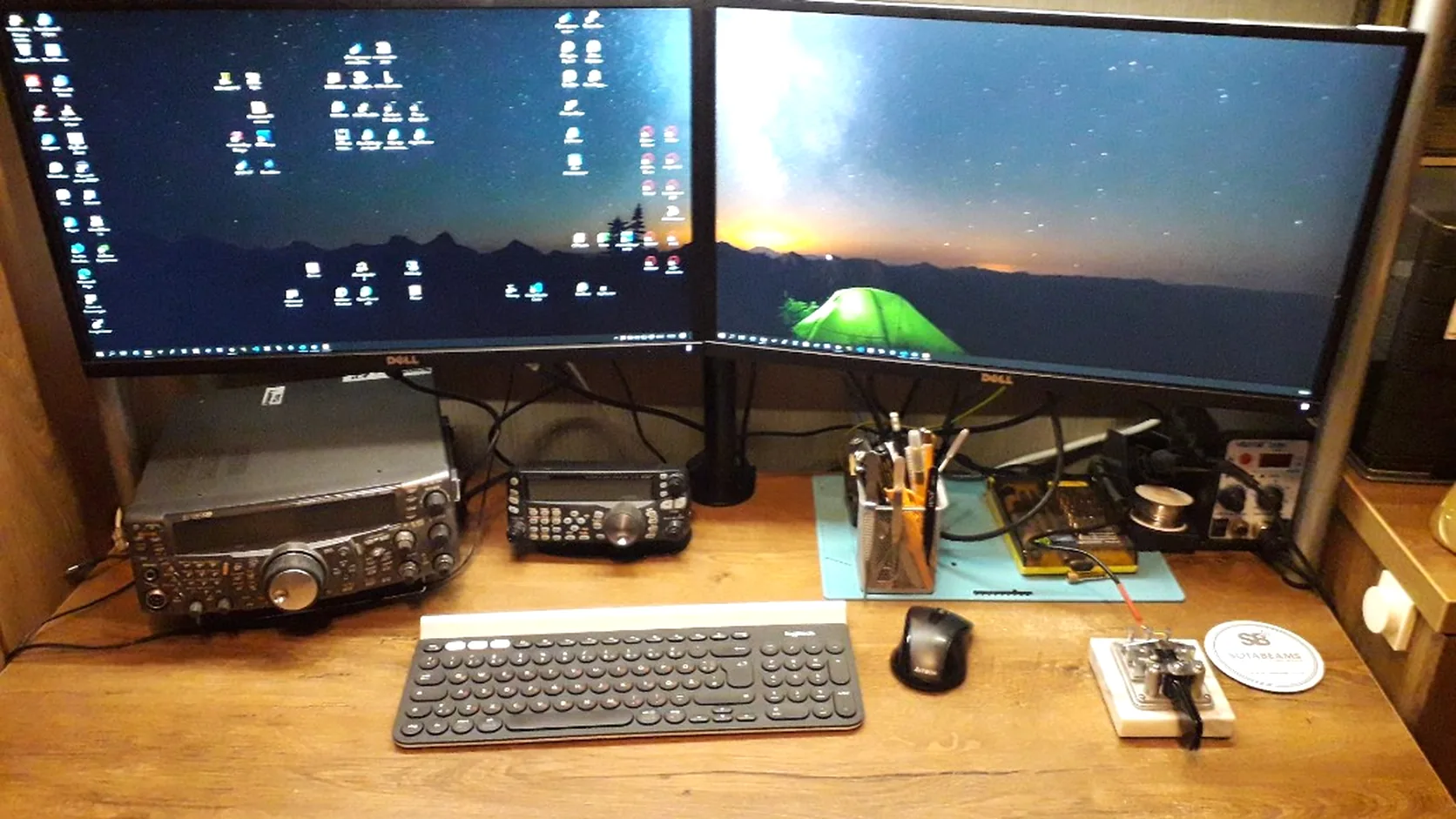
Anyone in Estonia can get their own callsign by passing the amateur radio qualification exam and obtaining a station licence from TTJA. This article walks you through it step by step: which class to choose, where to find the exam questions, how to book the exam, which documents to send and what it costs. It is written for people taking their first steps in ham radio.
In short
- You need two documents: the exam committee's qualification certificate and a TTJA station licence.
- Classes: D needs 15 of 20, B 30 of 40, A 40 of 50 correct answers, plus a test QSO (FM, SSB or CW).
- Power: A 1000 W, B 100 W, D 10 W; callsign suffix of 2, 3 or 4 letters.
- State fee 10 €, licence term up to 5 years, renew at least 15 days before expiry.
Contents
Certificate, licence and callsign
To get on the air you need two documents:
- Qualification certificate (kvalifikatsioonitunnistus). The exam committee issues it once you pass the exam. It states your class: D, B or A. The certificate alone does not let you transmit, but it entitles you to apply for a licence.
- Amateur radio station licence (amatöörraadiojaama tööluba). It is issued by TTJA (Tarbijakaitse ja Tehnilise Järelevalve Amet, the Consumer Protection and Technical Regulatory Authority). The licence carries your callsign: the unique combination of letters and digits that identifies your station on the air.
Exams and training are organised by ERAÜ (Eesti Raadioamatööride Ühing, the Estonian Radio Amateurs Society). It coordinates amateur radio nationwide and has been a member of the IARU (International Amateur Radio Union) since 1938. TTJA appoints the exam committees on ERAÜ's proposal.
There is no age limit, but applicants under 16 must attach written consent from a parent or guardian.
Classes D, B and A
Estonia has three licence classes. In each one the exam has a theory part (a multiple-choice test on radio electronics, propagation, regulations and operating practice) and a practical part: a test contact, or QSO, with a station chosen by the committee.
| Class | Questions | Correct answers needed | Answer options | Practical part |
|---|---|---|---|---|
| D | 20 | 15 | 3 | FM contact on VHF/UHF |
| B | 40 | 30 | 3 | SSB contact on HF |
| A | 50 | 40 | 4 | telegraphy (CW) contact |
The pass mark is 75 % for D and B and 80 % for A. D is for complete beginners, including pupils who have not yet studied physics at school. B is for more advanced candidates, and A is the highest class: it requires solid radio engineering knowledge and Morse skills. FM is frequency modulation, SSB is single sideband (the main voice mode on HF) and CW is Morse telegraphy. HF covers the bands up to 30 MHz, VHF/UHF the bands above 30 MHz.
Class privileges and power
Your class sets your bands, transmitter power and callsign length. The regulations give maximum power in dBW, decibels relative to 1 W: 10 dBW = 10 W, 20 dBW = 100 W, 30 dBW = 1000 W.
| Class | Suffix letters | Power, dBW | Power, W | Bands |
|---|---|---|---|---|
| A | 2 | 30 | 1000 | all amateur bands |
| B | 3 | 20 | 100 | all amateur bands |
| D | 4 | 10 | 10 | 80 m, 10 m, 6 m (50.2–52 MHz only), 4 m, 2 m, 70 cm, 23 cm |
The power figures apply to the main bands. Some segments have their own limits: for example, 1850–1955 kHz is limited to 10 W ERP, and in Ida-Viru County class A is limited to 20 dBW on 4 m. The full table is in Annex 3 to Ministerial Regulation No. 37, "Raadioamatöörile kvalifikatsiooni andmise ja raadiosageduste amatöörraadioside otstarbel kasutamise kord".
How to prepare for the exam
- Download the question pool for your class from the ERAÜ website: the D, B and A pools are published as separate PDFs. Online self-tests are also available for D and B.
- Read the Estonian amateur radio regulations in the ERAÜ section "Sidemäärused ja sagedusplaanid".
- Study regularly, a couple of hours a day over several weeks, rather than cramming the night before.
- Aim to understand rather than memorise. ERAÜ allows you to make and print your own formula sheet: an answer you can calculate is more reliable than one learned by heart.
- Find a club. A club has a shack, equipment and people who can help you prepare, especially for the practical part. If there is no club nearby, you can start one.
- Ask experienced hams, ERAÜ board members or exam committee members when something is unclear.
Booking and taking the exam
- Email
This email address is being protected from spambots. You need JavaScript enabled to view it. with the class you want and your region. They will refer you to the right committee and help you agree on a date. The list of regional committees is on the ERAÜ website, and exams in Tallinn are announced in the news section. - The exam starts with the theory part. If you don't know an answer, move on and come back to it at the end.
- Then comes the practical part, a test contact matching your class.
- Once you pass, you receive the qualification certificate. Keep a copy.
Applying to TTJA
- Pay the state fee (riigilõiv): as of the check date it is 10 € and does not depend on the licence term. Applications are not processed until the fee is paid.
- Submit the application in whichever way suits you: online in the TTJA system jvis.ttja.ee with your ID card (recommended), by digitally signed email, or by registered mail to TTJA, Endla 10A, 10122 Tallinn. For a first application, attach a copy of your certificate; a scan is enough.
- Choose the licence term: up to 5 years. ERAÜ recommends applying for the maximum term.
- Wait for the decision. TTJA issues the licence within 15 days once the documents and payment are checked. You can receive it by post or collect it in person.
Renew the licence at least 15 days before it expires. You also need to reapply when your details change: home address, station location or name. If you wish, you can obtain the harmonised HAREC certificate for a state fee of 16 €. The government has approved draft amendments that would extend the licence term to 10 years and raise the fee to 20 €. Check the current terms with TTJA before you apply.
How an Estonian callsign is built
A callsign has three parts: the prefix ES, the digit of the region where the station is registered, and the suffix. The suffix length depends on your class: two letters for A, three for B, four for D. Single-letter suffixes go to club (shared-use) stations.
| Digit | Region |
|---|---|
| 0 | Hiiu and Saare counties |
| 1 | Tallinn |
| 2 | Harju County, except Tallinn |
| 3 | Lääne, Rapla and Järva counties |
| 4 | Lääne-Viru and Ida-Viru counties |
| 5 | Tartu and Jõgeva counties |
| 6 | Põlva, Valga and Võru counties |
| 7 | Viljandi County |
| 8 | Pärnu County |
| 9 | nationwide, ERAÜ use only |
For example, an ES4 callsign with a three-letter suffix belongs to a class B amateur whose station is in Lääne-Viru or Ida-Viru County. You must give your callsign at least at the start and end of every contact.
From experience
The author of this article received his first callsign, ES4RLH, in 1991. It was a class B licence, with the three-letter suffix that goes with it. Later the author passed the class A exam and submitted a new application, which is how the current two-letter callsign ES4AW came about. Back then documents were filed on paper; online applications arrived relatively recently and make the process much easier. The author is a member of ERAÜ. His advice to newcomers: don't stop at the exam questions. Study electronics in more depth and explore the different sides of the hobby: awards, contests and more.
Common mistakes
- Going on the air with the certificate but before the TTJA licence is issued.
- Memorising answers instead of understanding formulas and principles.
- Starting to prepare a couple of days before the exam.
- Forgetting to pay the fee, or leaving out the payment reference "Amatöörraadiojaama tööloa taotlus" and your name.
- Missing the renewal deadline, or not updating the licence after moving house.
- Operating on bands or at power levels your class does not allow.
Glossary
- Callsign — the unique identifier of a radio station, e.g. ES4AW.
- QSO — a radio contact between two stations.
- TTJA — the Estonian regulator that issues licences and callsigns.
- ERAÜ — the Estonian Radio Amateurs Society, which runs the exams.
- HF / VHF/UHF — shortwave (up to 30 MHz) / bands above 30 MHz.
- SSB, FM, CW — single sideband, frequency modulation, Morse telegraphy.
- dBW — power in decibels relative to 1 W.
- HAREC — Harmonised Amateur Radio Examination Certificate, recognised in CEPT (European Conference of Postal and Telecommunications Administrations) countries.
What next
If you are just getting to know the hobby, start with Getting started in amateur radio: the first five steps.
Sources
- ERAÜ: Kuidas saada raadioamatööriks
- ERAÜ: Raadioamatööri eksam
- ERAÜ: ARJ tööloa taotlemine ja dokumentide vormid
- Riigi Teataja: Regulation No. 37, Annex 3 (bands and power)
- Riigi Teataja: Raadiokutsungite moodustamise ja väljastamise kord
- Riigi Teataja: Electronic Communications Act
- Riigi Teataja: State Fees Act