


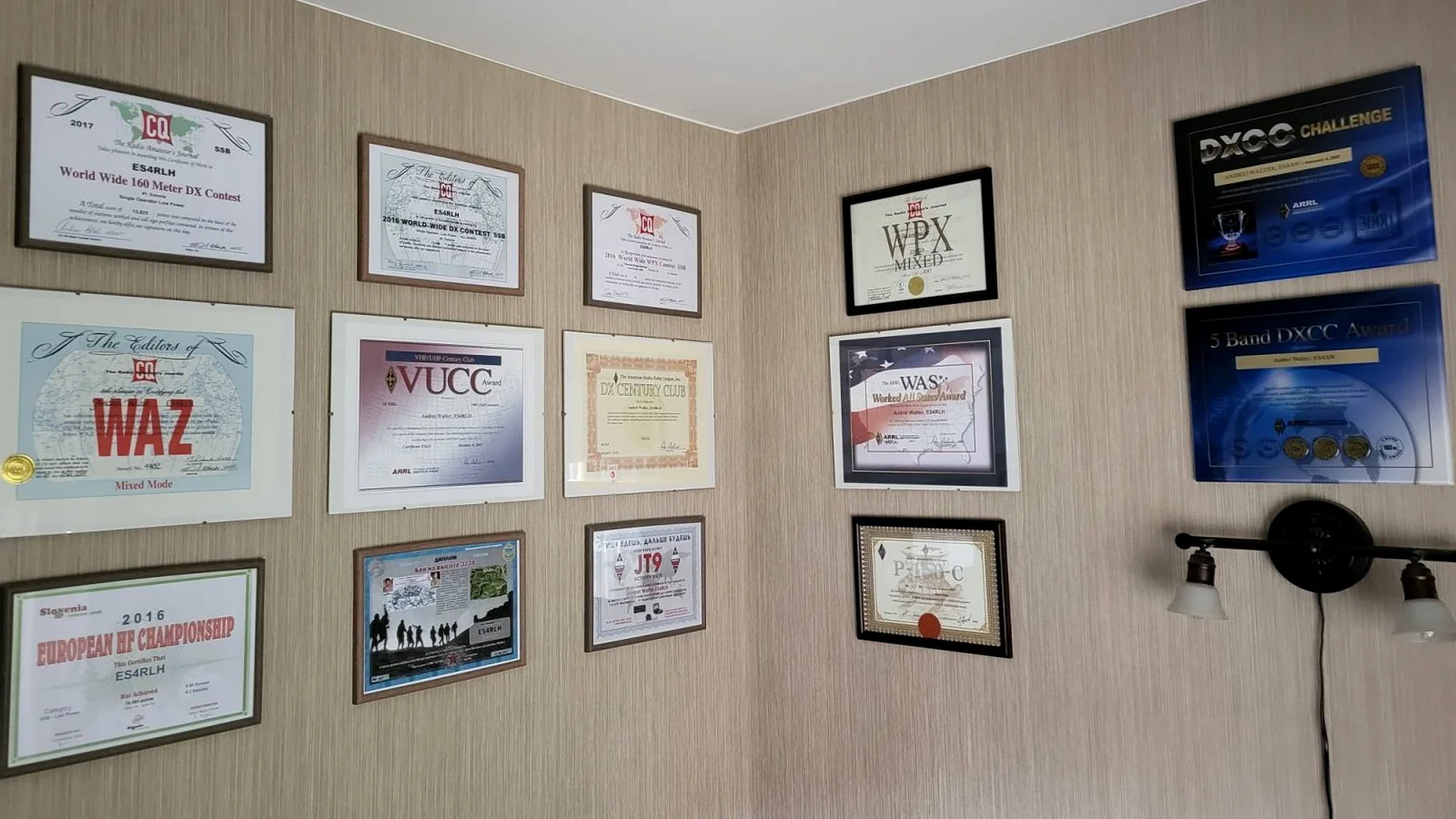
DXCC (DX Century Club) is the award every DXer aims for: work and confirm 100 entities on the ARRL list. This article covers what counts, which DXCC awards exist, how to confirm contacts through LoTW or paper QSL cards and what an application costs. Using ES4AW in Estonia as an example, it also shows what the road to 5BDXCC and the DXCC Challenge looks like.
In short
- The ARRL issues DXCC for 100 confirmed entities; the list has 340 current ones and the Honor Roll needs 331.
- Only LoTW and original QSL cards count; eQSL and Club Log are not accepted for DXCC.
- A LoTW confirmation is not yet a credit: contacts count only after a paid application.
- LoTW application: $9 for ARRL members and $18 for others, covering 101 QSOs, then $0.15 per QSO.
- ES4AW: Challenge (1000 points) in 2022 and 5BDXCC endorsed for 30, 17 and 12 m, on SSB and digital.
Contents
What DXCC is
The award is issued by the ARRL (American Radio Relay League), the national association for amateur radio in the USA. It is open to amateurs worldwide. ARRL membership is not required, but members pay lower fees.
DXCC counts entities, not countries. An entity can be a country, but also a separate island or territory defined by geographic and political criteria: for example, land separated from its "parent" by at least 100 km, or an island at least 350 km away across water. The ARRL list currently has 340 current entities. Only current entities count for 5BDXCC, the Challenge and the Honor Roll.
The ARRL issues 22 DXCC certificates and 4 plaques, plus endorsement stickers as you climb. For Mixed, Phone, CW, Digital and the 40–10 m bands, for example, stickers come at 150, 200 and 250 entities, then every 25 up to 300 and every 5 above 300.
What counts
- Only two-way contacts with land stations; contacts with ships, boats and aircraft do not count.
- All stations you use for one award must be in the same DXCC entity, and for each contact all transmitters and receivers must be within a 500 m diameter circle.
- A legally licensed remotely controlled station is allowed, but you may not use a station outside your home entity to build your home totals.
- Contacts must be made by the licensee personally. A club call sign cannot be used for individual credit, and you may not ask someone else to make contacts for you.
- Cross-mode contacts (SSB on one side and CW on the other, for example) generally do not count.
- A confirmation must show both call signs, the entity, mode, date, time and band.
Starting dates: most awards accept contacts from 15 November 1945, CW from 1 January 1975 (earlier CW contacts count toward Mixed) and Satellite from 1 March 1965. If your call sign changes within the same DXCC entity, your credits carry over.
DXCC award types
| Award | Requirement | Confirmation |
|---|---|---|
| Mixed | 100 entities, any modes | LoTW, QSL |
| Phone, CW, Digital | 100 entities on one mode | LoTW, QSL |
| Satellite | 100 entities via satellite | LoTW, QSL |
| Single-band | 100 entities on one band: 160–2 m, 70, 23, 13 and 3 cm (no award for 60 m) | LoTW, QSL |
| 5BDXCC | 100 entities on each of 80, 40, 20, 15 and 10 m; endorsements for 160, 30, 17, 12, 6 and 2 m | LoTW, QSL |
| 10-Band | plaque: 100 entities on each of 10 bands from 160 to 6 m | DXCC credits |
| Challenge | 1000 band-entity points on 160–6 m, excluding 60 m | LoTW, QSL |
| Trident | 100 entities each on CW, Phone and Digital | LoTW only |
| Honor Roll | at least 331 of the 340 current entities | LoTW, QSL |
| #1 Honor Roll | all 340 current entities | LoTW, QSL |
| QRP DXCC | 100 entities at 5 W or less | no QSLs needed |
Most people start with Mixed or with the award for their main mode. Digital covers FT8, FT4, RTTY and other digital modes. The ARRL introduced Trident in August 2025: it is based on LoTW credits only, and satellite contacts do not count. QRP DXCC is a one-time award with no endorsements.
Confirmations: LoTW and QSL
The ARRL accepts two kinds of confirmation: electronic ones through Logbook of The World (LoTW) and original paper QSL cards. Photocopies, faxes and emailed scans are not accepted. eQSL confirmations and Club Log entries do not count for DXCC, although Club Log is handy for statistics and for requesting cards through OQRS.
LoTW
- Register with LoTW and get a call sign certificate in TQSL. For call signs outside the USA, the ARRL asks for a copy of your licence and an identity document.
- Upload your log regularly through TQSL or from your logging software.
- Contacts that match the other station's log become confirmations (QSLs) in LoTW.
- Open your DXCC account in LoTW: it shows new confirmations that have not yet been credited.
- If you earned DXCC with cards earlier or operated under another call sign, ask the ARRL for a credit merge. Otherwise your LoTW totals will be incomplete.
- Select the new QSLs and submit an application directly in LoTW, paying the fee.
Note that a LoTW confirmation is not yet a credit. Until you apply and pay, those contacts are listed as New LoTW QSLs.
Paper QSLs through a card checker
You can mail cards to the ARRL, but having them checked by a DXCC Card Checker is easier and cheaper. A checker is an ARRL-approved ARRL member holding DXCC endorsed for at least 150 entities. 160 m cards may only be checked by a checker with an active 160 m DXCC. The Online DXCC process:
- Create an account in the Online DXCC system on the ARRL website.
- Enter your card data and pay for the application.
- Print and sign the application form.
- Send the form and the original cards to the nearest checker; operators in Estonia usually use checkers in Finland.
- The checker returns your cards and forwards the form to the ARRL. Once processed, the contacts appear in your DXCC account in LoTW.
A local checker has no limit on the number of cards per application; at hamfests and at ARRL HQ the limit is 120 cards per session.
Applying and fees
ARRL fees as of the check date (2026-11-28), in US dollars. "ARRL member" means a member living outside the USA.
| Method | Application, ARRL member | Application, non-member | Certificate, ARRL member | Certificate, non-member |
|---|---|---|---|---|
| LoTW | 9 | 18 | 12 | 15 |
| Online DXCC (cards) | 12 | 25 | 17 | 17 |
| Paper application | 16 | 25 | 17 | 17 |
The application fee covers 101 QSOs; each additional one costs $0.15. Shipping certificates (up to four) outside the USA costs $10 for members and $25 for non-members via LoTW, or $26 for card applications. Returning cards from the ARRL abroad costs $54–58 for a package of up to 100 cards. Plaques (5BDXCC, Challenge, Trident and others) are ordered separately with the DXCC Item Order Form. Check the fee page before applying: the ARRL does not state when the current fees took effect.
ES4AW in practice
The site's author, Andrei Walter, has been on the air since 1991: as ES4RLH until 2020 and as ES4AW since then. He operates SSB and digital modes with a Kenwood TS-480 and a TS-2000 into a vertical GP antenna. There are no CW contacts in his DXCC totals.
- 2018: first DXCC award as ES4RLH. In September 2018: 204 entities worked, 182 confirmed, 935 Challenge points.
- December 2020: 216 worked, 193 confirmed, 1006 Challenge points via LoTW.
- January 2022: a card from Singapore brought the 100th entity on 80 m.
- 4 February 2022: DXCC Challenge plaque for 1000 points. Around the same time, ES4RLH and ES4AW were merged in LoTW.
- Later: 5BDXCC for ES4AW, endorsed for 30, 17 and 12 m.
Andrei sent paper cards to a checker himself twice. The process is slow, and in his experience electronic confirmations can also take up to two years, but in the end every contact is kept in LoTW.
ES4AW's DXCC account in LoTW (author's screenshot):
| Mode / band | Credited by ARRL | New in LoTW | Total |
|---|---|---|---|
| Mixed | 207 | 34 | 241 |
| Phone | 114 | 2 | 116 |
| Digital | 197 | 37 | 234 |
| 160 m | 22 | 9 | 31 |
| 80 m | 102 | 0 | 102 |
| 40 m | 152 | 10 | 162 |
| 30 m | 135 | 3 | 138 |
| 20 m | 177 | 8 | 185 |
| 17 m | 159 | 39 | 198 |
| 15 m | 154 | 47 | 201 |
| 12 m | 103 | 67 | 170 |
| 10 m | 104 | 59 | 163 |
| 6 m | 61 | 2 | 63 |
| Challenge (points) | 1169 | 244 | 1413 |
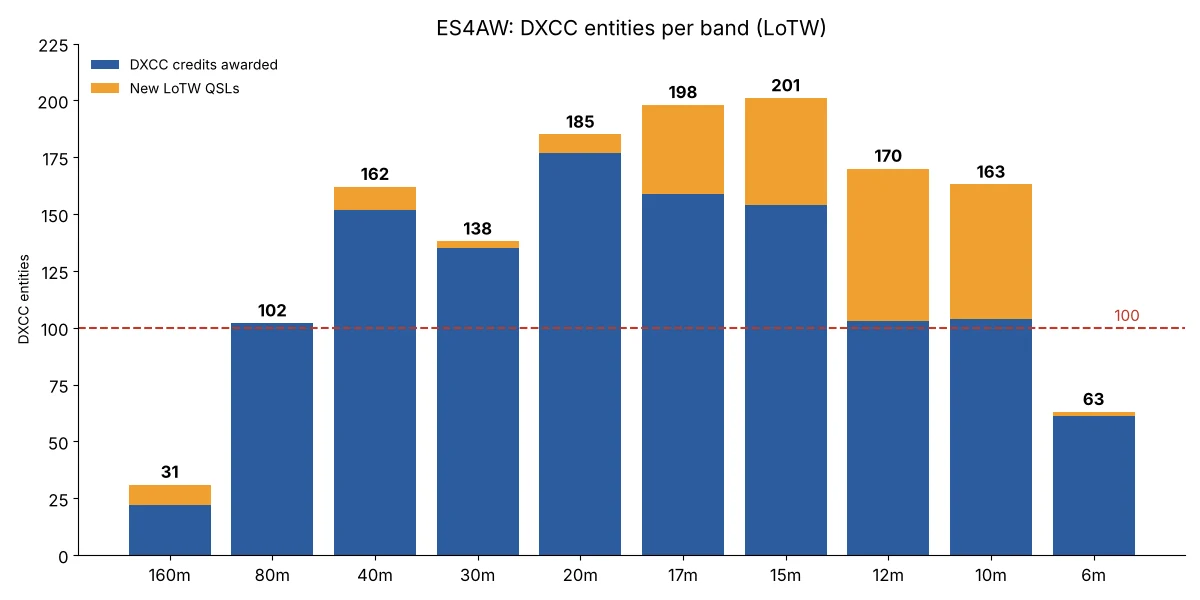
Far more is confirmed than credited: on 12 and 10 m LoTW already shows 170 and 163 entities, while the credits stand at 103 and 104. Those are contacts that have not yet been submitted.
The author's advice:
- Keep your log in software that tracks DXCC (Andrei uses DXKeeper). It shows which entities are confirmed on which bands and which are only worked.
- Use a good DX cluster and follow DXpedition news: rare entities are on the air only briefly.
- On 80 m, leave the receiver running overnight and check the reception-report sites to see who was heard. Asia and Australia around 20:00–22:00, South and Central America after 03:00, the Americas until 09:00 local time.
Common mistakes
- Assuming LoTW confirmations are already credited: credits only appear after you apply.
- Not merging an old call sign or a card-based DXCC record with your LoTW account, so part of your total "disappears".
- Sending copies or scans of cards: only originals or LoTW are accepted.
- Relying on eQSL or Club Log for a DXCC application.
- Adding contacts made through a remote station in another entity to your home totals.
- Confusing a DXCC entity with a country: Alaska, for example, is a separate entity from the USA.
- Sending 160 m cards to a checker who does not hold 160 m DXCC.
Sources and links
- ARRL: DXCC
- ARRL: DXCC rules
- ARRL: DXCC fees
- ARRL: DXCC Trident
- ARRL: card checking (DXCC Card Checkers)
- QRZ.RU: DXCC award description (2003, fees out of date)
- hf-uhf.eu forum: DXCC thread
On this site: WCA award rules.